Who Is James Burrows? Net Worth, Career & Legacy
Who Is James Burrows? James Burrows was an American television director, producer, and sitcom architect best known for shaping some of the most beloved comedy series in TV history, including Cheers, Taxi, Friends, Frasier, and Will & Grace. For many viewers, his name appeared only briefly in the credits.
But inside Hollywood, Burrows was the director producers called when a comedy pilot needed rhythm, warmth, sharp timing, ng, and a real chance at survival. After his death on June 19, 2026, interest in James Burrows’ biography, age, net worth, career, family, and income sources surged again because his work is woven into decades of American popular culture.
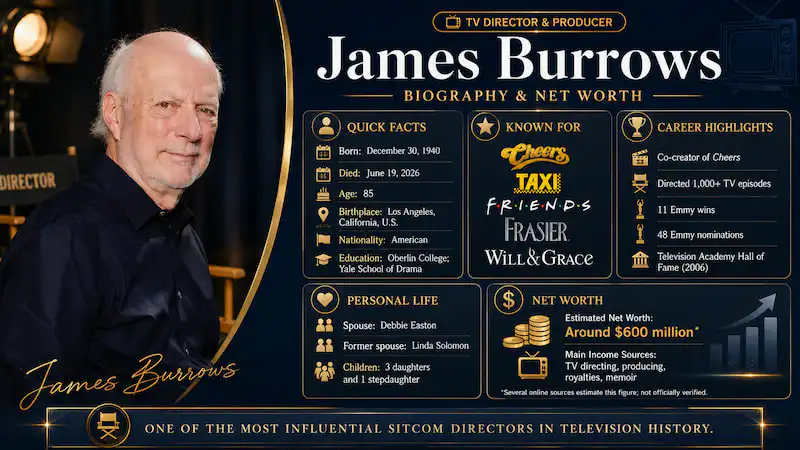
Quick Facts
| Detail | Information |
|---|---|
| Full Name | James Edward Burrows |
| Popular Name | James Burrows, Jimmy Burrows |
| Date of Birth | December 30, 1940 |
| Date of Death | June 19, 2026 |
| Age | 85 at the time of death |
| Birthplace | Los Angeles, California, United States |
| Nationality | American |
| Profession | Television director, producer |
| Education | Oberlin College; Yale School of Drama |
| Marital Status | Married at the time of death |
| Spouse | Debbie Easton |
| Former Spouse | Linda Solomon |
| Children | Three daughters and one stepdaughter publicly reported |
| Known For | Cheers, Taxi, Friends, Frasier, Will & Grace |
| Current Residence | No reliable public current residence data found (Not publicly confirmed) |
| Estimated Net Worth | Several online sources estimate around $600 million, but this figure is not officially verified (Not publicly confirmed) |
| Main Income Sources | TV directing, producing, royalties, syndication-related income, memoir royalties |
| Active Years | Television career from the 1970s until 2025 |
| Official Website | No reliable official personal website found (Not publicly confirmed) |
| Official Social Media Profiles | No reliable verified personal social media profiles found (Not publicly confirmed) |
These details reveal a public figure whose reputation was built behind the camera rather than in front of it. Burrows’ identity was tied to craft, consistency, and influence. He was not a celebrity in the modern influencer sense, but his creative fingerprints reached millions of households.
Official Sources
Early Life and Background
James Edward Burrows was born in Los Angeles on December 30, 1940, into a family already connected to American entertainment. His father, Abe Burrows, was a respected Broadway writer, director,r and humorist. That background mattered. James grew up close to rehearsal rooms, performers, and the language of timing long before he became one of television’s great comedy directors.
After his family moved to New York, Burrows’ world became more theatrical. He attended the High School of Music & Art and spent part of his youth around stage culture. There is a sense that he absorbed directing before he formally chose it. The stage taught him how bodies move, how pauses land, and how laughter depends on both words and silence.
| Early Life Detail | Information |
|---|---|
| Birthplace | Los Angeles, California |
| Childhood Base | New York after moving from Los Angeles |
| Father | Abe Burrows, Broadway writer and director |
| Early Influence | Theater, music, stage work,k and live performance |
| Early Creative Environment | Broadway and television-adjacent circles |
Burrows’ early environment gave him something many television directors spend years trying to learn: how to think like an actor and a stage manager at the same time. That combination became central to his later work.
Education
Burrows studied at Oberlin College and later attended the Yale School of Drama. His education did not simply give him credentials; it gave him discipline. Yale exposed him to directing, stagecraft, and the intense collaboration required to move a scene from page to performance.
| Education | Details |
|---|---|
| High School | High School of Music & Art, New York |
| College | Oberlin College |
| Graduate Training | Yale School of Drama |
| Career Relevance | Theater training shaped his approach to sitcom blocking, pacing, and actor direction. |
What made Burrows unusual was the way he carried theater values into television. He treated a sitcom episode almost like a short play: actors needed rhythm, blocking had to feel natural, and the audience’s laughter was part of the performance.
Career Journey
James Burrows did not become a major television director overnight. Before his sitcom breakthrough, he worked in theater, regional productions, and stage management. His television break came in the 1970s when he connected with MTM Enterprises, the company behind The Mary Tyler Moore Show. That opportunity placed him near some of the era’s sharpest comedy writers and performers.
His career took a sharp turn with Taxi, where he proved he could direct ensemble comedy with emotional texture. Then came Cheers, the NBC sitcom he co-created with Glen Charles and Les Charles. Cheers became one of the defining comedies of the 1980s and early 1990s, and Burrows directed most of its episodes.
| Period | Career Milestone |
|---|---|
| 1960s | Early work as a dialogue coach and theater professional |
| 1974 | Began directing for MTM Enterprises |
| Late 1970s | Directed Taxi episodes |
| 1982 | Co-created Cheers |
| 1990s | Directed major shows, including Frasier and Friends |
| 1998–2020 | Directed Will & Grace across its original run and revival |
| 2010s–2025 | Continued directing pilots, revivals, and sitcom projects |
Watching the career unfold, it is hard not to notice how often Burrows appeared at the beginning of major shows. He had a gift for pilots. Producers trusted him to establish tone, cast chemistry, and visual rhythm before a series had found its footing.
Major Achievements
James Burrows’ achievements are not limited to awards, though the awards are significant. His deeper achievement was creative durability. For more than five decades, he remained relevant in a constantly changing medium.
| Achievement | Details |
|---|---|
| Emmy Awards | 11 Emmy wins publicly reported |
| Emmy Nominations | 48 nominations listed by the Television Academy |
| Television Academy Hall of Fame | Inducted in 2006 |
| DGA Recognition | Multiple Directors Guild of America awards and nominations |
| Major Shows | Taxi, Cheers, Frasier, Friends, Will & Grace |
| Career Scale | Directed more than 1,000 television episodes |
Burrows helped define the multi-camera sitcom as a living, breathing performance format. He knew how to keep a joke from feeling mechanical. Actors often spoke of his ability to protect the room, sharpen a scene, and make performers feel trusted.
Businesses, Investments, and Income Sources
James Burrows’ income came mainly from television. Unlike directors whose fortunes are built through blockbuster films, Burrows built wealth through volume, longevity, producing credits, and association with some of the most profitable sitcoms in American TV history.
| Income Source | Status |
|---|---|
| Television Directing Fees | Publicly supported by career credits |
| Producing Fees | Publicly supported by producer credits |
| Sitcom Royalties and Residuals | Likely major income source, exact figures not publicly confirmed |
| Backend Participation | Possible through major projects, exact terms not publicly confirmed |
| Memoir Royalties | Directed by James Burrows |
| Speaking/Industry Appearances | Possible, but the exact income is not publicly confirmed |
His most important income streams likely came from directing, producing, and long-tail television revenue. Shows like Cheers, Friends, Frasier, and Will & Grace continued to circulate through syndication, streaming, and global licensing, which helps explain why net worth estimates around him are unusually high for a television director.
Net Worth Analysis
Several online sources estimate James Burrows’ net worth at around $600 million, but this figure is not officially verified (Not publicly confirmed). Estimates vary across sources, and the exact figure has not been publicly confirmed.
That number, if close to accurate, would reflect more than standard directing fees. Burrows spent decades attached to series that became rerun staples. His career included co-creator credit on Cheers, executive producer roles, pilot direction, and work across shows that generated enormous long-term value.
| Wealth Factor | Likely Role in Net Worth |
|---|---|
| Directing Career | Core professional income |
| Producing Credits | Significant income source |
| Cheers Co-Creation | Potentially major long-term value |
| Syndication and Residuals | Likely important, exact figures not public |
| Memoir | Secondary income source |
| Real Estate | No reliable public data found (Not publicly confirmed) |
The safest reading is this: Burrows was almost certainly a very wealthy television figure, but the exact figures should be treated with caution. His wealth profile looks less like a one-time payday and more like decades of recurring value from shows that never really left the culture.
Personal Life
James Burrows was married to Debbie Easton at the time of his death. He was previously married to Linda Solomon. Public reports identify three daughters from his first marriage and a stepdaughter from Debbie Easton’s previous marriage.
| Personal Detail | Information |
|---|---|
| Spouse | Debbie Easton |
| Former Spouse | Linda Solomon |
| Children | Three daughters and one stepdaughter publicly reported |
| Grandchildren | Seven grandchildren publicly reported |
| Father | Abe Burrows |
| Mother | Ruth Burrows |
Burrows did not build his public image around personal disclosure. His private life appeared quieter than his professional legacy. That restraint fits the way many people viewed him: not as a self-promoter, but as a working director whose relationships with actors and writers were central to his reputation.
Public Image and Influence
James Burrows was widely seen as a director’s director. His public image was built on trust, comic timing, and mentorship. Many actors described him as generous, exacting,g and warm. That balance matters. Comedy sets can become tense when timing fails, but Burrows had a reputation for making actors feel safe enough to take risks.
His influence is also cultural. Cheers shaped the hangout sitcom. Friends became a global comfort-watch phenomenon. Will & Grace helped bring gay lead characters into mainstream network comedy. Burrows did not create all those cultural shifts alone, but he helped stage them, shape th, em and make them playable for audiences.
Social Media Presence
James Burrows did not appear to maintain a major verified personal social media presence. His online footprint is mostly professional: IMDb, Television Academy pages, interviews, industry profiles, and clips from shows he directed.
| Platform | Presence |
|---|---|
| No reliable verified personal profile found (Not publicly confirmed) | |
| X/Twitter | No reliable verified personal profile found (Not publicly confirmed) |
| IMDb | Public professional profile available |
| Television Academy | Public biography and interview available |
| DGA | Public visual history interview available |
That limited social presence reinforces an older model of fame. Burrows’ brand was not built through daily posting. It was built through work that kept replaying.
Interesting Facts About James Burrows
- James Burrows was the son of Broadway writer and director Abe Burrows.
- He co-created Cheers with Glen Charles and Les Charles.
- He directed more than 1,000 television episodes.
- He was especially respected for directing comedy pilots.
- He directed all episodes of Will & Grace across its original run and revival.
- His training in theater strongly shaped his sitcom style.
- He was inducted into the Television Academy Hall of Fame in 2006.
- His 2022 memoir is titled Directed by James Burrows.
- He worked into his eighties, with credits continuing into the 2020s.
Future Plans and What Comes Next
Because James Burrows died in June 2026, plans now belong to his legacy rather than new personal projects. The next chapter will likely involve retrospectives, renewed interest in his memoir, streaming rediscovery of his shows, and industry tributes from performers he helped guide.
His influence will remain visible in every ensemble comedy that tries to balance sharp writing with emotional warmth. Future sitcom directors will continue to study his blocking, pilot work, and actor-first approach, even if they never met him.
FAQs
Who is James Burrows?
James Burrows was an American television director and producer best known for directing major sitcoms such as Cheers, Taxi, Friends, Frasier, and Will & Grace.
What is James Burrows known for?
He is known for shaping the modern multi-camera sitcom, co-creating Cheers, directing more than 1,000 TV episodes,s and helping launch many successful comedy series.
How old was James Burrows?
James Burrows was 85 years old when he died on June 19, 2026.
What was James Burrows’ net worth?
Several online sources estimate James Burrows’ net worth at around $600 million, but the exact figure is not officially verified (Not publicly confirmed).
How did James Burrows make money?
He made money through television directing and producing, possible royalties, syndication-related income, backend participation, and memoir royalties.
Was James Burrows married?
Yes. James Burrows was married to Debbie Easton at the time of his death. He was previously married to Linda Solomon.
What shows did James Burrows direct?
His credits include Taxi, Cheers, Frasier, Friends, Will & Grace, The Big Bang Theory, Two and a Half Men, Mike & Molly, and many others.
Where is James Burrows now?
James Burrows died on June 19, 2026. His legacy continues through the television shows, actors,s and directors he influenced.
Why James Burrows Still Matters?
James Burrows’ story is not simply the story of a successful television director. It is the story of how invisible craft can shape public memory. Viewers may remember Sam walking into the bar on Cheers, the six friends gathering in Monica’s apartment, or Will and Grace trading lines in a New York living room. Behind many of those moments was a director who knew where to place the camera, when to hold for laughter, and when to let actors breathe.
That is why people continue to search for James Burrows. His name leads to a larger question about television itself: who makes comedy feel effortless? In Burrows’ case, the answer was a man with theater in his bones, patience on set,t and an instinct for ensemble chemistry that few directors ever match.
His career is now complete, but his work is not finished. It keeps playing, streaming, rerunning, and teaching. For a director who spent most of his life behind the camera, James Burrows left a remarkably visible mark.