On a Friday morning, the Tom Bradley International Terminal at LAX appears to be many different things at once. It smells of coffee, recycled air, and the unique nervousness of someone who might have miscalculated how long the security line would take. Everyone is pulling something on wheels, the floors are hard, and the lighting is fluorescent. To put it another way, it is really unglamorous. However, there’s a good chance that someone in that terminal is dressed more elegantly than they would be if they had an appointment for supper.
One of the more closely examined fashion statements in modern media is the airport attire. Celebrity arrivals at major airports, such as JFK, Heathrow, CDG, and Narita, are increasingly the subject of special attention on fashion websites, YouTube channels, and Instagram accounts that are dedicated to documenting what people wore while traveling. The stroll from the arrival gate to the car waiting on the curb has been deemed fashion-relevant by the content machine, and it has been correct for long enough that celebrities now concur and dress appropriately.
This historical arc makes a lot of sense, so it is worthwhile to comprehend. Flying was costly enough to be truly elite in the 1950s and 60s, and there was a definite social code around it. Grace Kelly did not wear cozy clothes when she boarded an aircraft. Elizabeth Taylor and Audrey Hepburn didn’t either. The airport required the same presentation as any other public event where appearance had social significance, including structured suits, gloves, and heels. You could tell from their attire that this person saw travel as an extension of their visible life rather than a practical inconvenience.
As air travel became more accessible, there was a steady movement toward casualness. By the 1990s, supermodels like Kate Moss and Cindy Crawford were being photographed wearing tattered leather jackets and denim, a style known as “model off-duty,” which was really just a way of saying “fashion credibility applied to clothes that felt uncontrived.” The models piqued the interest of the paparazzi, but what was captured in the pictures was a distinct relationship between effort and style. The airport was one of the few places where it was possible to capture the new signal of looking good without appearing to be trying.
The athleisure trend of the 2010s significantly increased the comfort factor. In a way that would have been unimaginable forty years ago, “celebrity travelling” became synonymous with matching tracksuits. The reasoning was simply pragmatic: more people were flying more frequently, traveling internationally required spending long hours in a pressurized tube, and the social cost of appearing unflattering at an airport had decreased to the point where comfort prevailed. However, the details were important even in the tracksuit era. A $35 grocery sweatsuit and a $600 Loro Piana cashmere set are very different, and the majority of the subjects of the photos fell into the second category.
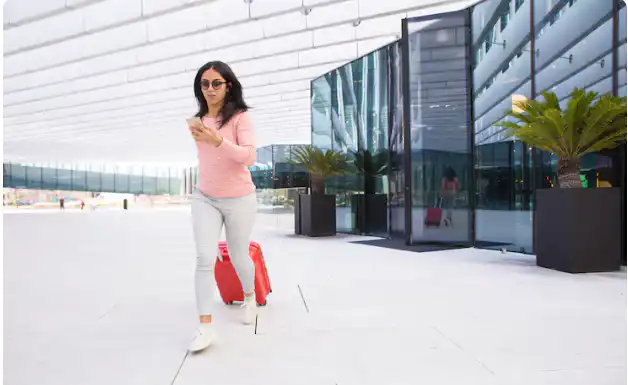
Right now, we are in a position that could be characterized as purposeful ease. Tailored, wide-leg pants that look like proper pants but feel like pyjamas. A long trench coat or oversized shearling that unifies the ensemble aesthetically and offers real warmth in the heavily air-conditioned station. An huge designer bag that costs more than most people’s monthly rent and can fit a laptop, a face spray, a neck pillow, and a novel. minimal trainers or slip-on loafers that pass security checks without requiring people to stoop and re-tie anything. In the same way that Grace Kelly’s structured suits were made to appear effortless, the airport outfit in 2026 is a problem solved with pricey components. In other words, it is only effortless in appearance.