A dinner party is the only place where you can feel that certain kind of discomfort. The fake smiles, the wine that is poured too quickly, and the talk that avoids the one thing that everyone in the room is really thinking about. That’s exactly how Olivia Wilde’s movie The Invite makes you feel, and the movie is built around that quiet agony.
The setup looks a lot easier than it really is. Two groups. One table for dinner. There are noise complaints that no one is brave enough to name. Joe and Angela, played by Seth Rogen and Olivia Wilde, are in the middle of remodeling their house and falling apart as a marriage. Hawk and Piña, played by Edward Norton and Penélope Cruz, move in next door and have an open, talkative relationship that makes everything feel almost too happy. “People caring very deeply about something they can’t say, I find it very funny,” Wilde has said on the record. “What unfolds is less of a plot and more of a pressure cooker.” The laughs come not from the punchlines but from the horrible release of everything that wasn’t said. It seems like a very simple observation, but it explains why people have been laughing out loud at film festivals since its Sundance premiere in January, even in the more formal screening rooms where people tend to keep their reactions to themselves.
The emotional core of the story can be seen in the production itself. After Wilde joined the project with a new cast, screenwriters Rashida Jones and Will McCormick couldn’t make a full redraft. The original plan was for Jonathan Dayton and Valerie Faris to direct, with Amy Adams, Paul Rudd, and Tessa Thompson attached. Most studio productions would have quietly turned down Wilde’s idea to combine the rewrite and rehearsal into one two-week process. She then got the cast and writers together to improvise, confess, and build the characters from the inside out.
To be honest, it sounds like it could have gone badly very easily. There is, however, a sense that the screen directly showed how vulnerable the process was. Wilde calls it a “collective confession” because the actors talk about their own personal histories, ideas about healthy relationships, and what they’ve learned in therapy in order to help the audience understand two made-up couples at a dinner table. It takes a long time to build up that much trust. This also explains why the movie has a worn-out look that is really hard to fake.
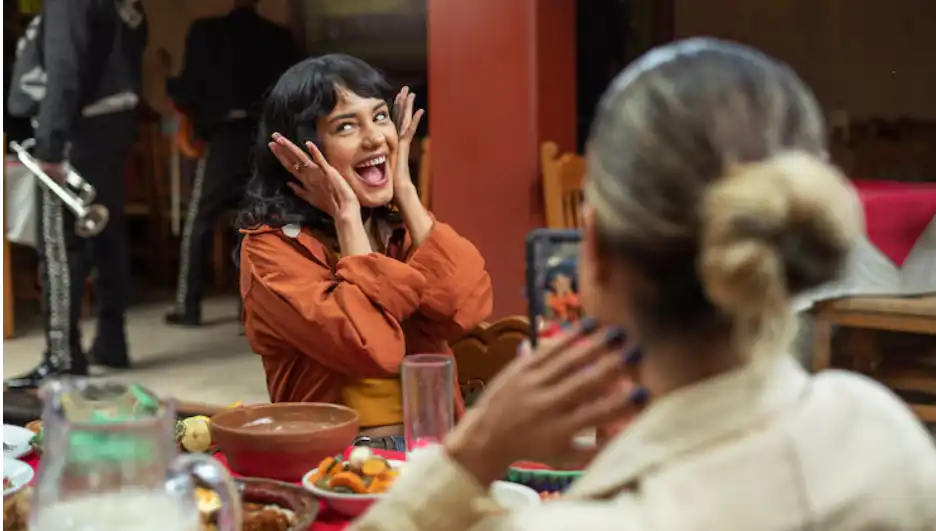
Rogen was free to improvise during the one-location shoot, which Wilde insisted on filming in order. He came up with at least two jokes that were so sharp that Wilde broke character on camera. She didn’t cut around her reaction; instead, she kept it. The character whose husband she had grown to hate still laughs at him. Even though it wasn’t planned, that one small thing says more about the marriage than a few pages of canned dialogue.
Just as interesting is where and how The Invite is landing. The film went to A24 after one of the fiercest bidding wars at Sundance, with Warner Bros. Clockwork, Focus, Searchlight, NEON, Apple, Sony, Amazon, and Netflix all interested. Not because A24 offered the most money—Netflix is said to have—but because Wilde really wanted the movie to be shown in theaters and found a partner who did too. That choice seems almost stubborn, and it’s hard not to respect it.
Wilde has been honest about what she sees as a slow change in how comedies are distributed that hasn’t been looked into much. The idea was that The Invite would probably end up on a streaming service. This was even thought while it was being made. Strongly, she says no to that. Having a phone in your hand makes it impossible to fully enjoy this kind of comedy, which is based on glances, pauses, and the audience filling in the blanks. It needs a space. Everyone needs to be ready to pay attention and sit still.
It’s still not clear if one well-reviewed, independently made satire about a dinner party is enough to change the way comedies are made and released in a fundamental way. Most likely not by itself. But at least The Invite makes its point clear, and in a full theater, that point is made more strongly than on a Tuesday night when seen on a laptop screen.